
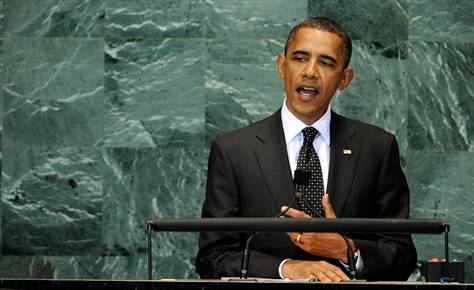
Capitalism key to alleviating poverty, Obama tells UN
Saying “decades of experience” prove that corruption-free competition creates opportunity, Obama said a key part of a new U.S. approach to aiding developing nations will spotlight countries that advance political and economic freedom.
“The United States will focus our development efforts on countries like Tanzania, that promote good governance and democracy; the rule of law and equal administration of justice; transparent institutions with strong civil societies and respect for human rights,” Obama told leaders and representatives of almost 140 countries attending the third and last day of the summit.
“Because, over the long run, democracy and economic growth go hand in hand.”
The gathering is reviewing progress on eight development goals that emerged after promises all UN member states made at the world body’s 2000 Millennium summit.
A number of studies show that a significant portion of the advances in the so-called Millennium Development Goals — whose deadline for being met is set at 2015 — has resulted from increased living standards in the developing countries whose economies are growing the fastest.
Obama offered examples of capitalism’s success in combating poverty, saying the “force” of broad-based economic growth had transformed South Korea from a recipient of aid to an aid donor, and is raising living standards “from Brazil to India.”
But the message runs counter to that brought by a number of the most outspoken countries at the UN, among them Cuba, Iran and Bolivia — all of which have delivered speeches this week that blame just about all of the poor-world’s ills on Western-led capitalism.
Against that backdrop, Obama delivered his “capitalism” message late in his speech — describing it as the “third pillar” of his administration’s new three-pillar approach to aiding the developing world.
The first two deal with how and where the United States will invest aid dollars against a backdrop of re-oriented diplomatic and trade initiatives aimed at encouraging development.
“Let me be clear, the United States of America has been and will remain, the global leader in providing assistance,” Obama reassured the gathering as he spoke of what he called his administration’s “new U.S. Global Development Policy.”
In the United States, Obama has faced a barrage of criticism from the political right over his administration’s pursuit of “big government” intervention to counter the economic downturn.
But it is because of its capitalist base that many at the UN criticize the United States — even as Washington is the world’s biggest contributor to the world body and many of the most extensive development initiatives.
Indeed, the United States and other rich countries were the main targets Wednesday for aid requests that could reach as high as $169 billion in the coming years to back a new UN-driven initiative to advance maternal and child health.
UN Secretary General Ban Ki-moon said the world body was beginning with $40 billion already pledged for the project, which aims to save the lives of 16 million women and children over the next five years.
Ban cited Canada as one of the countries that has contributed to the overall goals of improving maternal and child health, which were among the slowest moving when the Canadian government elevated them for special focus in its overall aid program.
With Canada as host, the June Group of Eight summit pledged $7.3 billion for maternal and child health care by 2015, while Canada will spend $2.85 billion on it.
Save the Children Canada president David Morley on Wednesday called the G8 and UN initiatives “launching points for a renewed focus to save the lives of mothers and children.”
World leaders at the UN gathering were Wednesday night set to endorse a 31-page declaration that calls for stepped-up efforts to achieve all eight development goals by 2015.
Many are seriously behind schedule — in great part because of a slowdown in aid and economic expansion resulting from the world economic slowdown.
Aid groups say the goals should remain a priority.
“It’s important to keep repeating the commitments the governments make regardless of the economic crisis because one of the biggest challenges we are facing is how does our government and how do we, as a people, behave in the middle of slowdown,” said Dave Toycen, president and CEO of World Vision Canada and a member of the Canadian ministerial delegation for the summit.
“Obviously it is common sense that we have to help the people that are marginalized in our own country, but to use it as an excuse to curtail or restrict our overseas aid when there are so many other areas on the budget that can be looked at is bad for our conscience and it is bad economics over the long run.”
 Freedom News Group