
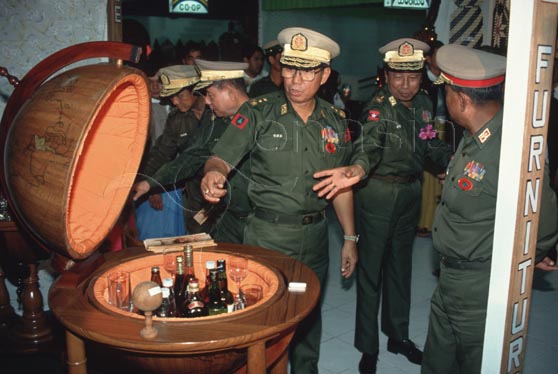
Caption: Yangon, Yangon Division, Myanmar – Apr 1994. Lt-General Tun Kyi, centre, was Mandalay commander in 1988 during pro-democracy demonstrations. He withdrew his forces to the Mandalay fort, where some looked likely to defect for a while. The uprising in Mandalay was put down with an estimated 34 deaths – relatively light by comparison with Rangoon and other population centres. Tun Kyi was regarded as the most business-orientated of the generals and boasted of his transformation of the skyline of Mandalay. He was brought to Rangoon and made Minister of Foreign Trade. His reputation for corruption and high-handedness grew until he was purged in the late 1990s and sent into obscure retirement. \Lt-General Tin Oo (right), or ‘Secretary 2’, a hardliner and fourth most powerful general in the Burmese junta. As army chief of staff, he was regarded as a hardliner who occasionally made rabid speeches against what he considered to be opposition elements. He died aged 67 on 19 February 2002 after his Russian-made MI-17 helicopter crashed shortly after takeoff into the Salween River. There were rumours of a fight on board, but many still believe the accident was due to overloading and/or poor maintenance. Others noted that there had been earlier apparent attempts on Tin Oo’s life. In April 1997 a parcel bomb mailed from Japan killed his older daughter. Five months earlier, two bombs went off at a religious site in Yangon that he had just left, killing five and wounding 17. \The generals are pictured at the opening of a new department store.
Credit: Dominic Faulder/OnAsia.com
Contact: sales@onasia.com
Legal Notice: Any use of this picture is subject to a license agreement entered into by the user and OnAsia Images Ltd. All other rights reserved. Any re-use and redistribution of this image is prohibited. For sales enquiries regarding any additional use of this or other pictures from OnAsia Images please contact sales@onasia.com
 Freedom News Group